Article
What Is Alios? A 5-Minute Introduction for Startup Founders
Alios is an operations system built for startup teams. Learn how the Alios startup management tool works — through speed, visibility, and ownership principles.
What Is Alios? A 5-Minute Introduction for Startup Founders
For startup founders, time is the scarcest resource. That's why when trying a new tool, the first question is usually not "what does this do?" but "what does this get me?"
If Alios had to be defined in one sentence: an operations tool that lets startup teams manage work, decisions, and files in a single system.
But that definition isn't concrete enough. A better question is: what problem does it solve?
What Problem Does Alios Solve?
Most startups hit the same three questions at a certain point.
"Where did this end up?" A task was assigned, but there's no tracking. Who's doing it, when it finishes, whether it's stuck — finding out requires sending a message.
"Why did we make that decision?" A decision was made, but where, when, and why it was made isn't on record. Two months later, the same debate starts again.
"Where was that file?" The relevant document is somewhere in Drive, the link is in Slack, and nobody remembers who shared it.
If these three questions are being asked dozens of times a day, the team is spending a large part of its time searching for work rather than doing it. Alios was designed to eliminate these three questions.
Three Core Principles: Speed, Visibility, Ownership
Alios is built on three principles.
Speed: Entering the system, opening a task, writing an update should be frictionless. If using the tool takes longer than doing the work, nobody will use it. Opening a node and assigning an owner in Alios takes 30 seconds.
Visibility: Everyone on the team should be able to see the status of all work at any moment without asking. Who's doing what, what's stuck, what's done — none of that should require a meeting or a message.
Ownership: Every task has one owner. There is no ownerless work. This principle both increases accountability and prevents "I thought you were doing it" situations.
How Does Alios Work?
The basic building block of Alios is the node. Every project, every task, every process is a node. Inside nodes live:
What the task is and why it's being done — in the description field. Who owns it — in the owner field. When it needs to be finished — in the deadline field. What stage it's in — in the status field. Related files and links — in the reference field.
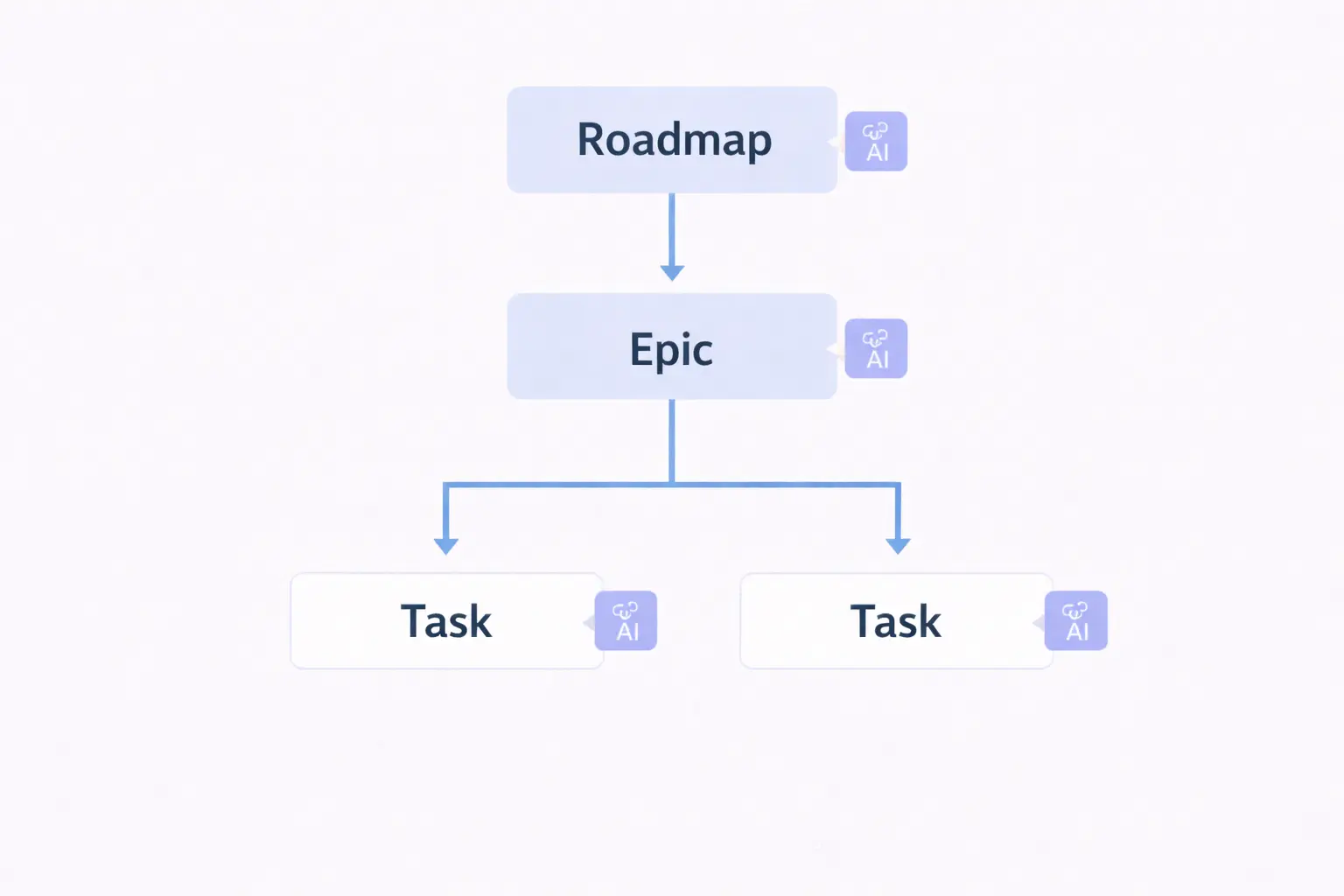
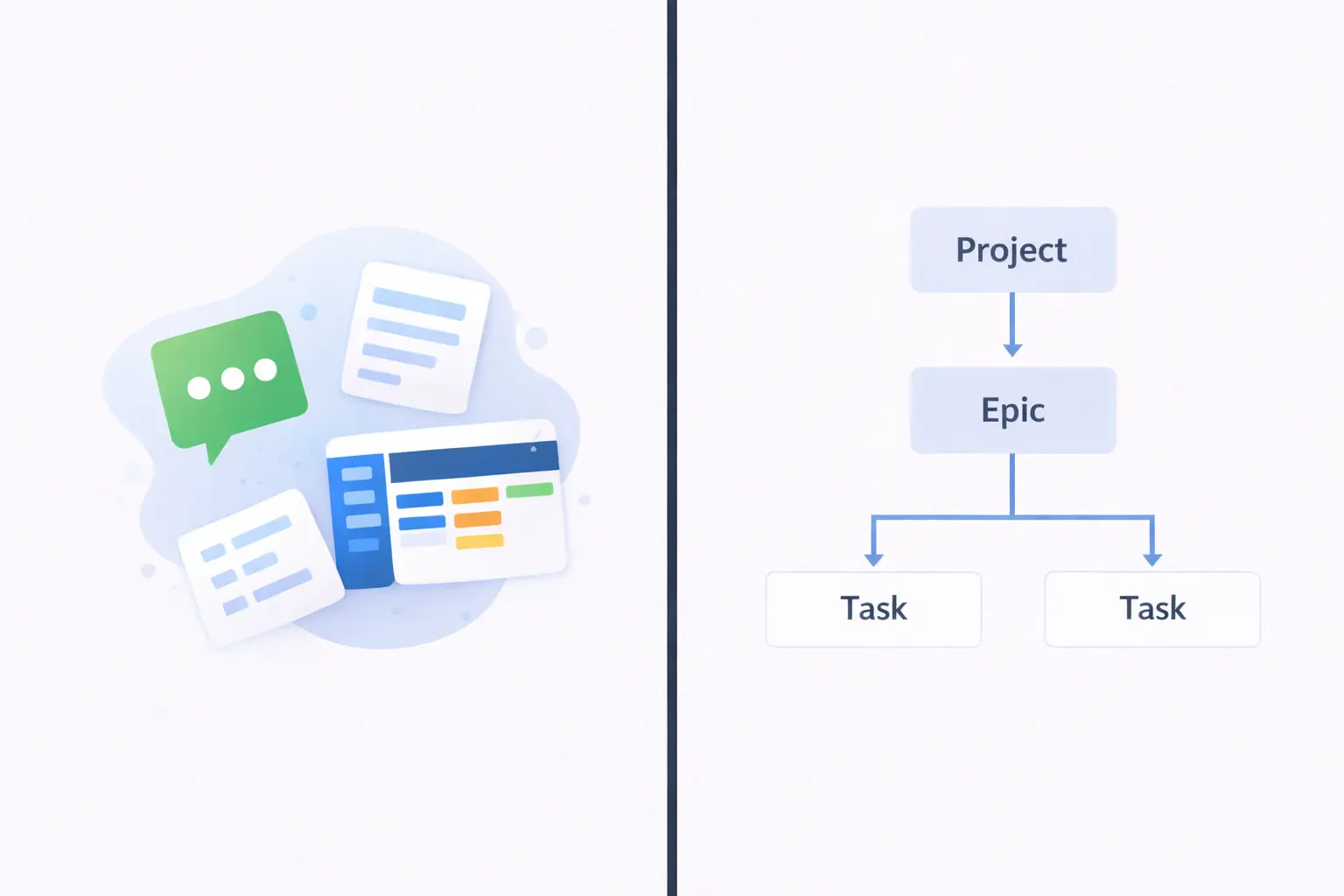
Nodes are arranged hierarchically: epics under a top-level project node, tasks under epics. This hierarchy builds an unbroken chain from strategic goal to daily work.
Real-World Scenario: Launch Preparation
A concrete example teaches more than an abstract explanation. Here's how a startup set up its product launch preparation in Alios.
Context: 5-person team, launch in 3 weeks. The product is ready but marketing, communications, technical infrastructure, and customer onboarding are still incomplete. Everything is in people's heads, nothing is in the system.
Step 1 — Open the Top-Level Node
📁 LAUNCH PREPARATION — [Date]
Description: The product's first public launch.
Goal: By [Date], all channels ready,
first 50 users onboarded.
Owner: [Founder name]
Deadline: [Launch date]
This node is the umbrella for all launch work. Everyone looks here to see the overall picture.
Step 2 — Create the Epics
Four epics are opened under the top-level node:
📁 Technical Preparation
📁 Marketing and Content
📁 User Onboarding
📁 Launch Day Operations
Each epic can progress independently. The marketing team produces content without waiting for technical preparation.
Step 3 — Distribute the Tasks
Concrete, assignable tasks are opened under each epic:
📁 Technical Preparation
├── [ ] Final production env check — Ali — 3 days before
├── [ ] Run load test — Ali — 5 days before
├── [ ] Set up error monitoring — Mehmet — 1 week before
└── [ ] Test backup procedure — Mehmet — 3 days before

📁 Marketing and Content
├── [ ] Write launch blog post — Zeynep — 1 week before
├── [ ] Social media calendar — Zeynep — 10 days before
├── [ ] Prepare press kit — Zeynep — 2 weeks before
└── [ ] Send announcement to email list — Ayşe — 2 days before

📁 User Onboarding
├── [ ] Test onboarding flow — Ayşe — 1 week before
├── [ ] Write welcome email — Ayşe — 10 days before
├── [ ] Prepare support documentation — Mehmet — 1 week before
└── [ ] First 50 users list — Founder — 3 days before

📁 Launch Day Operations
├── [ ] Create launch day checklist — Founder — 1 week before
├── [ ] Confirm team task assignments — Founder — 3 days before
├── [ ] Write emergency protocol — Ali — 5 days before
└── [ ] 48-hour post-launch monitoring plan — Ali — launch day
Step 4 — Daily Visibility
The founder opens the top-level node every morning. Which tasks are complete, which are stuck, which deadlines are approaching — all visible at a glance. No need to send messages. No need to schedule a meeting.
When a task gets stuck, the owner writes "waiting on this for this reason" in the node description. The founder sees that note and steps in if needed.
Step 5 — Post-Launch Archive
When the launch is complete, the top-level node is closed but not deleted. Three months later, when the question "what did we do for the launch?" comes up — for an investor update, a retrospective, planning the next launch — that node is opened and the entire history is right there.
Who Is Alios Not For?
To be honest, Alios isn't ideal for every team.
For teams past 100 people that need enterprise approval workflows, Jira or similar tools may be a better fit. For someone who only needs a personal task list, a simple todo app is enough.
Alios works best in this profile: teams of 3–20 people, startups that need to move fast but also need to keep visibility into what's where. Those trying to get past post-MVP chaos. Those who want to reduce the number of tools and consolidate into one system.
Final Thought
As a startup management tool, Alios focuses on one thing: letting the team work without having to ask "what are we doing, who's doing it, where did it go?"
Launch preparation, sprint management, client onboarding, weekly planning — all of these can be managed in the same system with the same structure. Setup takes less than a week. The habit settles in within a few weeks.
No complex configuration is needed to get started. Open a top-level node, distribute the tasks underneath, assign the owners. Everything else develops as you use it.