Article
One System in the AI Era: Alios Instead of Notion Jira Slack
Tool fragmentation gets worse as AI speeds up. Learn how to replace Notion Jira Slack with one system in Alios — for solo devs, 2-person teams, and 5-person teams.
One System in the AI Era: Alios Instead of Notion Jira Slack
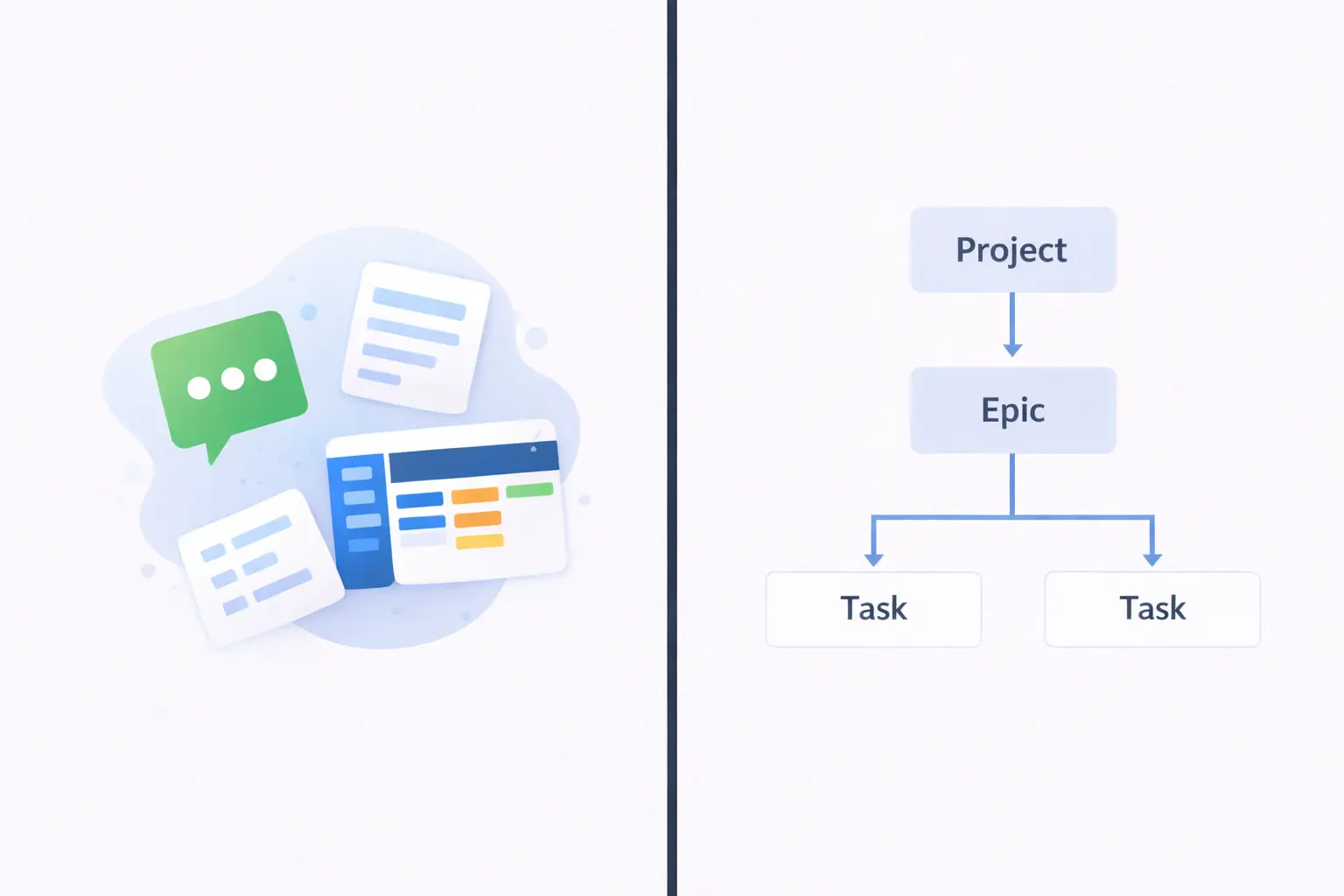
A technical team's tool inventory usually looks like this: Jira for sprint management, Notion for documentation, Slack for coordination, GitHub for PR tracking, Confluence for the technical wiki. Maybe Miro for architecture diagrams.
Every tool was added with good intentions. Every tool was chosen to solve a problem. But over time, the tools themselves became the problem.
When the question "where was that decision made?" comes up, the answer is: "We wrote it in Slack but I don't know which channel, or it's somewhere in Notion, or it was in a Jira ticket comment." This answer means the information is lost.
The Cost of Tool Fragmentation
As tool count increases, coordination cost silently grows.
Context loss. A task in Jira, the decision related to that task in Slack, the technical detail in Notion. Navigating three tools is needed to combine all three. A new team member doesn't know where to start.
Synchronization cost. A task updated in Jira doesn't update the Notion document. A decision made in Slack doesn't make it to Jira. Keeping data consistent across tools becomes a job in itself.
Meeting need increases. When information is scattered, people gather to synchronize. "Five-minute sync" meetings are actually a symptom of tool fragmentation. If information were in one place, the meeting wouldn't be needed.
In the AI era, this cost doubles. AI accelerated decisions, increased PR count, grew the volume of parallel work. Context loss and coordination cost multiply alongside more decisions, more PRs, and more parallel work.
What Single Source Actually Means
Single source doesn't mean "manage everything in one tool." It means "it's clear where every piece of information lives."
In Alios, this is built across four layers.
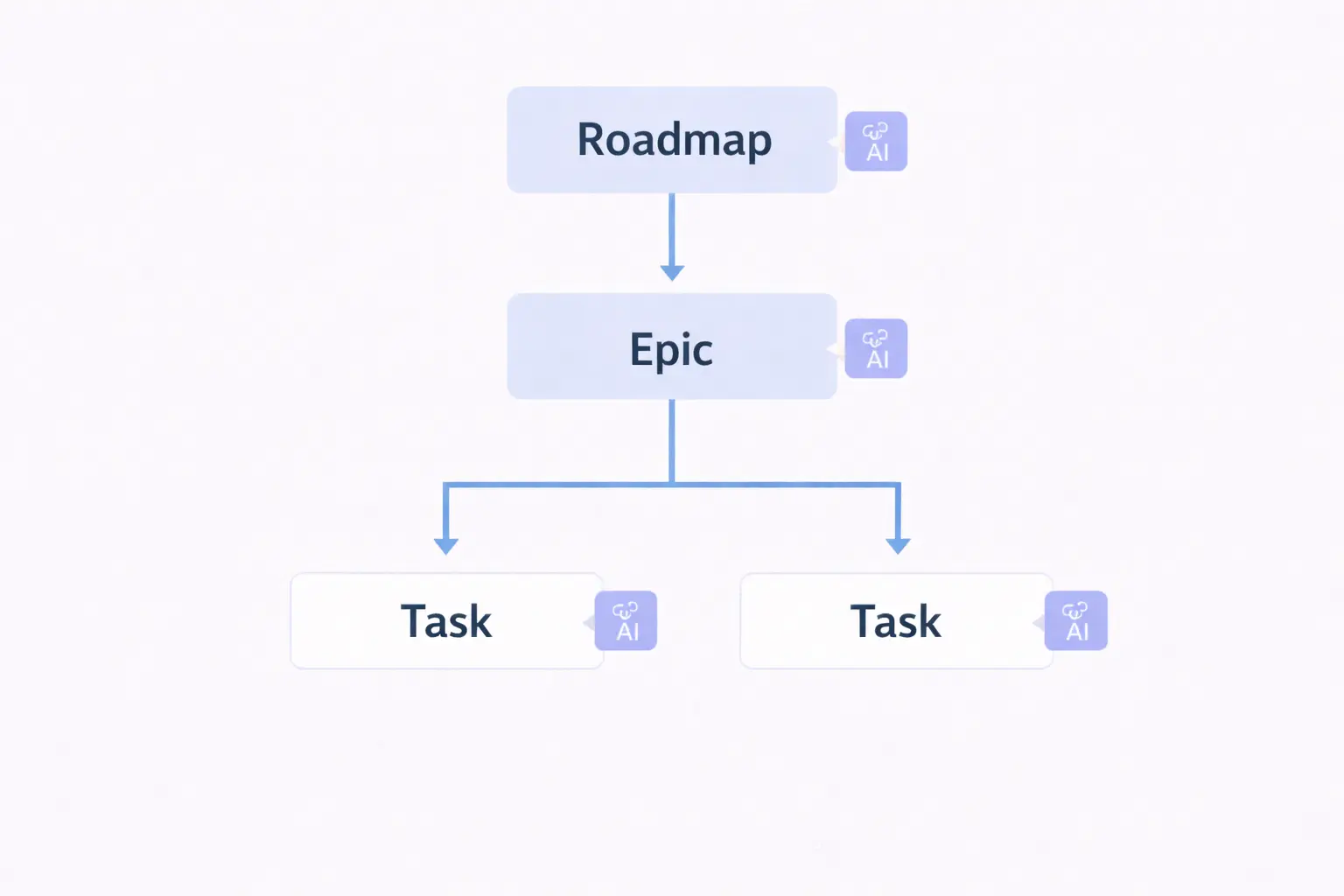
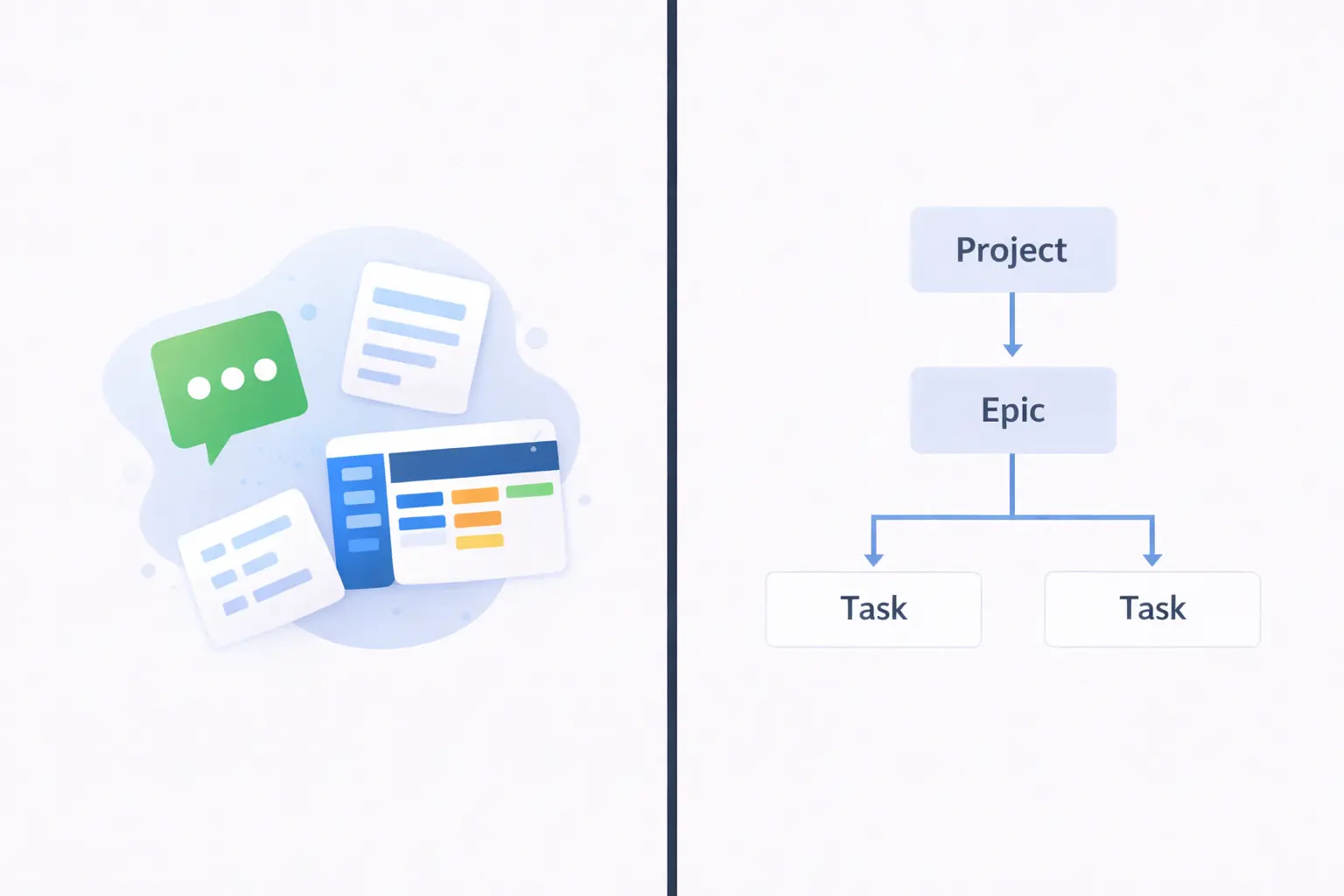
Project tree: Everything from roadmap goal to daily task is hierarchical. Top goal → epic → task. Every node's connection to the top goal is visible.
Statuses: Every task is in a clear status. Backlog, In Progress, Waiting, Review, Done. The question "where is this?" gets answered by looking at the node.
Ownership: Every node has an owner. The question "who is doing this?" gets answered by looking at the assigned person.
Decision record: Every important decision lives in a node description. Context, options, rationale, consequences. The question "why did we do it this way?" gets answered by looking at the node.
When these four layers are in place, Slack gets used for notifications, not coordination. Notion stops being a document repository — decisions live in nodes. Jira becomes unnecessary because Alios handles the same work with less complexity.
Scenario 1: Solo Developer
For a solo developer, tool fragmentation looks different but is equally costly. The question "what did I do this for?" goes unanswered two months later.
📁 ACTIVE PROJECTS
│
├── 📁 [Project A] — SaaS Product
│   ├── 📁 This Week
│   │   ├── 📌 Auth module — JWT implementation
│   │   │   Status: In Progress
│   │   │   Deadline: Wednesday
│   │   │   Acceptance criteria: Login/logout/
│   │   │   refresh working, token expires in 7 days
│   │   │
│   │   └── 📌 Dashboard API — user metrics
│   │       Status: Backlog
│   │       Deadline: Friday
│   │       Dependency: Auth must be DONE
│   │
│   ├── 📁 Backlog
│   │   ├── 📌 Email notification service
│   │   ├── 📌 Admin panel CRUD
│   │   └── 📌 Stripe integration
│   │
│   └── 📁 Decision Records
│       ├── 📌 DECISION — Auth: JWT vs Session
│       └── 📌 DECISION — DB: PostgreSQL vs MongoDB
│
└── 📁 [Project B] — Freelance Work
    └── [Same structure]
Solo dev daily routine:
Morning (10 minutes): Look at "This Week" nodes. Decide what will finish today. Check for dependencies.
During the day: Close a node when a task finishes. Open a node when a new idea or decision comes up. AI-assisted decision → go to "Decision Records."
Evening (5 minutes): Add a note to half-done nodes. Mark tomorrow's priority.
For a solo developer, Alios's core value is memory. Two months later, the questions "why did I choose JWT, why did I design this endpoint this way?" get answered by looking at the decision record nodes. No Slack, no Notion — everything is in the project.
Scenario 2: 2-Person Team
In a two-person team, coordination problems surface in the first sprint: who is doing what, who is waiting for whom, when will the review happen. When these questions get resolved through Slack, a "what's your status?" message arrives every day.
📁 SPRINT 5 — March 17-21
Sprint goal: Payment flow approved in staging,
user profile deployed live.
│
├── 📌 Stripe webhook integration
│   Owner: Ali (backend)
│   Status: In Progress
│   Deadline: Tuesday
│   Acceptance criteria:
│   • Successful payment webhook processed
│   • Failed payment logged
│   • Test scenarios passing
│   Dependency: None
│
├── 📌 Payment history page
│   Owner: Mehmet (frontend)
│   Status: Waiting
│   Deadline: Thursday
│   Dependency: Stripe webhook must be DONE
│   Waiting note: API endpoint expected.
│   Ali said he'll finish Tuesday.
│   Started with mock data for now.
│
├── 📌 User profile update
│   Owner: Mehmet
│   Status: Review
│   Deadline: Today
│   PR: #47 — Ali will review
│
└── 📋 DECISION RECORDS
    └── 📌 DECISION — Stripe amount: Decimal→Integer
        Date: March 15
        Context: AI-generated code returned Decimal,
        Stripe expects integer. Learned from INC-001.
        Decision: Explicit integer conversion required
        on all amount fields.
2-person team rules:
Nodes get updated every morning — without messaging. The question "what's your status?" gets answered by looking at the node. If there's a dependency, it moves to Waiting and a note gets written: what is being waited on, from whom, by when. When a PR is opened, the task moves to Review and a reviewer gets assigned — SLA: 24 hours. Sprint end: both people, 10 minutes — completed items, carried-over items, learning note.
For a two-person team, Alios's value is breaking the "what's your status?" cycle. Every morning nodes get checked, no sync meeting needed. When a decision is made, it gets written into the node, not into Slack.
Scenario 3: 5-Person Team
With five people, coordination complexity multiplies. Parallel epics, cross-dependencies, different areas of expertise. Jira setup looks tempting but feels heavy. A Notion + Slack hybrid stays inconsistent.
📁 Q3 GOAL — Enterprise Onboarding
Owner: Selin (PM)
Deadline: September 30
Success criteria: Onboarding time from 5 days to 1 day
│
├── 📁 EPIC 1 — RBAC (Role-Based Access)
│   Owner: Ali (Backend Lead) — Deadline: Sep 15
│   Status: In Progress
│   │
│   ├── 📌 RBAC data model — Ali — Sep 2 ✅
│   ├── 📌 RBAC middleware — Ali — Sep 5 🔄
│   ├── 📌 Frontend permission hook — Mehmet — Sep 9 ⬜
│   ├── 📌 Admin role management UI — Mehmet — Sep 12 ⬜
│   └── 📌 RBAC integration test — Zeynep — Sep 15 ⬜
│
├── 📁 EPIC 2 — Team Invitation System
│   Owner: Mehmet — Deadline: Sep 22
│   Status: Backlog — starts when EPIC 1 complete
│   Dependency: RBAC must be DONE
│   │
│   ├── 📌 Invite API — Ali — Sep 17 ⬜
│   ├── 📌 Email template — Can — Sep 17 ⬜
│   ├── 📌 Invite acceptance flow — Mehmet — Sep 20 ⬜
│   └── 📌 Invite list UI — Mehmet — Sep 22 ⬜
│
├── 📁 EPIC 3 — Onboarding Wizard
│   Owner: Mehmet — Deadline: Sep 29
│   Status: Backlog — starts when EPIC 2 complete
│   │
│   ├── 📌 Wizard step structure — Mehmet — Sep 24 ⬜
│   ├── 📌 Progress save API — Ali — Sep 24 ⬜
│   └── 📌 Analytics events — Can — Sep 26 ⬜
│
├── 📁 ACTIVE SPRINT — Sprint 8 (Sep 1-5)
│   Sprint goal: RBAC middleware and data model
│   approved in staging.
│   │
│   ├── 📌 RBAC middleware — Ali — Sep 5 🔄
│   ├── 📌 Middleware unit tests — Zeynep — Sep 5 🔄
│   └── 📌 PR Review — RBAC data model — Kerem ✅
│
└── 📋 DECISION RECORDS
    ├── 📌 DECISION — RBAC: Flat vs Hierarchical roles
    ├── 📌 DECISION — Invite: Token expiry 24h vs 48h
    └── 📌 DECISION — Wizard: Multi-page vs Single-page
5-person team roles and weekly rhythm:
Selin (PM) owns top goals and epics, writes sprint goals, approves epic closing criteria. Ali (Backend Lead) owns backend tasks, writes architectural decision records, reviews backend PRs. Mehmet (Frontend Lead) owns frontend tasks, leads Epics 2 and 3. Zeynep (QA) owns test checklist nodes, approves integration tests. Can (Full-stack) handles cross-cutting tasks, email, and analytics.
Monday (30 minutes — sprint planning): Sprint goal written, tasks assigned to owners, dependencies written into nodes. Wednesday (15 minutes — risk check): Waiting nodes scanned, Review nodes exceeding SLA scanned, is the sprint goal at risk? Friday (20 minutes — sprint close): Completed items, carried-over items, retrospective note in 3 lines, any missing decision records?
Notion + Jira + Slack vs. Alios
Question: "Why did the auth decision land on JWT?"
Notion + Jira + Slack:
→ Search Jira ticket comments
→ If not found, search Slack
→ If not found, ask the person who made the decision
→ If that person is no longer at the company: no answer
Time: 10-30 minutes, uncertain outcome

Alios single system:
→ Search "DECISION — Auth"
→ Node opens: context, options, rationale are written
Time: 30 seconds, certain outcome
When this difference is experienced several times a day, weekly coordination cost becomes visible.
Final Thought
The tool count problem doesn't get solved by adding more tools. The solution is clarifying where every piece of information lives.
In Alios, the project tree, statuses, ownership, and decision records build this clarity. The solo developer doesn't lose their memory. The two-person team breaks the "what's your status?" cycle. The five-person team coordinates across epics without scheduling meetings.
In the AI era, reducing tool count isn't losing speed — it's gaining context.