Article
Technical Team Weekly Status Report: Done in 10 Minutes
A weekly status report shouldn't be a chore for technical teams. Learn how to produce your technical team weekly status report in 10 minutes using Alios.

Technical Team Weekly Status Report: Done in 10 Minutes

Friday afternoon. Development isn't finished, a PR review is waiting, a bug appeared. And a weekly report also needs to be written.
For most developers, the weekly status report is the most dreaded 45 minutes of the week. Completed tickets get gathered from Jira, decisions get dug out of Slack, notes get pulled together from Notion. The result is an inconsistent, incomplete summary. The same process repeats next week.
Reporting isn't a chore. But when information is scattered, it becomes one.
Why Technical Reporting Takes So Long
There's one reason preparing a weekly status report takes so long: the time spent gathering information is greater than the time spent writing the report.
Information lives in multiple places. Completed tasks in Jira, decisions in Slack, opened PRs in GitHub, notes in Notion. Pulling these together takes longer than the report itself.
The format changes every week. No standard template exists. Last week's report gets referenced, that one's incomplete too. Every report gets built from scratch.
Context has evaporated. Remembering Monday's decisions on Friday is hard. Important details get skipped while answering "what did we do this week?" The report stays shallow.
Translation is needed for non-technical readers. "PR #42 was merged" is meaningless to a founder. "Payment integration completed, ready to go live" is meaningful. This translation requires extra thinking.
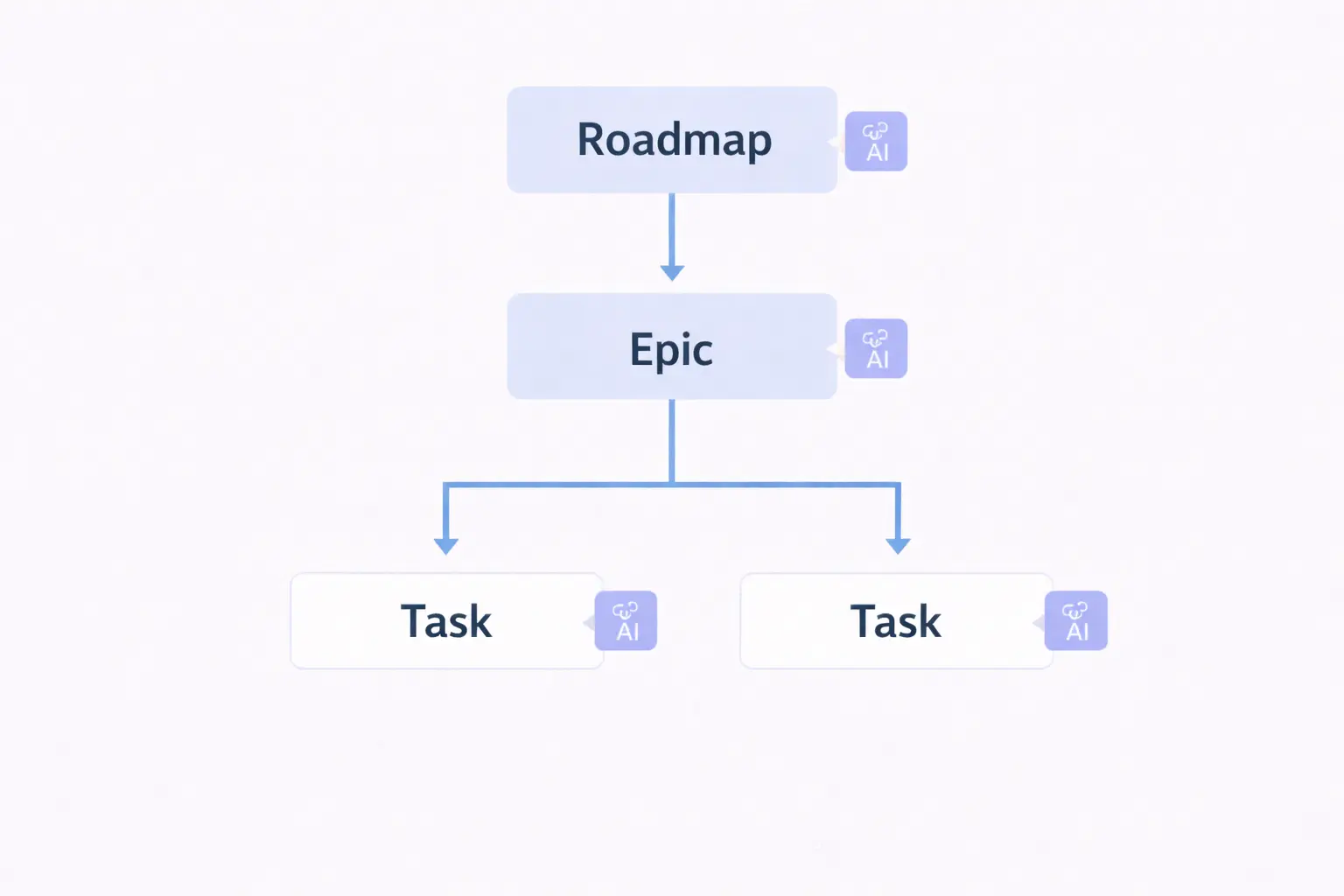
All of these steps disappear when nodes are kept current throughout the week. What remains isn't writing a report — it's assembling one. And assembly takes 10 minutes.
The Technical Team Report Format in Alios
The technical team weekly status report has four sections. The content of each section already lives in Alios nodes — it just needs to be transferred.
Section 1 — Completed
Nodes that moved to "Done" status this week. For each item, not technical detail but the work output.
✅ COMPLETED

- [Task name] → [What it means, what it achieved]
- [Task name] → [Output or impact — 1 sentence]
- [Task name] → [Numerical result if applicable]
Note for technical teams: "Refactor was done" isn't a completion. "Payment module refactored, query time dropped from 340ms to 95ms" is a completion.
Section 2 — In Progress and Waiting
Nodes currently in "In Progress" and "Waiting" status. For each item, the current state and any blockers.
🔄 IN PROGRESS

- [Task name]
  Status: [N]% — [Where it is, what stage]
  Estimated completion: [Date]

⏸ WAITING

- [Task name]
  Waiting on: [What's being waited for, from whom]
  Expected resolution: [Estimated date]
  Impact: [What else this blocker is delaying]
Section 3 — Risks
Risks noticed this week that could have impact next week. Technical debt, dependencies, resource gaps, estimate drift.
⚠️ RISKS

- [Risk description]
  Impact: [Low / Medium / High]
  Likelihood: [Low / Medium / High]
  Action: [Step taken or needed]
Section 4 — Next Week's Priorities
"Critical" and "High" priority nodes for the coming week.
➡️ NEXT WEEK

- [Task name] — Owner: [Name] — Target: [Date]
- [Task name] — Owner: [Name] — Target: [Date]
- [Task name] — Owner: [Name] — Target: [Date]

📎 Related Alios nodes: [Sprint or project name]
Full Example: Technical Team Weekly Report
📋 TECHNICAL TEAM WEEKLY STATUS REPORT
Week: March 17–21, 2025
Team: Backend + Frontend (3 people)
Prepared by: Ali

✅ COMPLETED

- Stripe webhook integration completed
  → Payment failure notifications now work in real
  time. Manual checking is no longer needed.

- User profile photo upload feature deployed
  → JPG, PNG, WebP supported. Auto-compression
  active, average file size dropped 68%.

- Session timeout bug fixed
  → Ticket open for 3 weeks now closed. Session
  drop issue on mobile Safari confirmed in staging.

- Database query optimization — dashboard module
  → Average load time dropped from 2.1s to 0.4s.
  5 queries merged, 2 N+1 issues resolved.

🔄 IN PROGRESS

- Role-based access control (RBAC)
  Status: 60% — Backend complete, frontend
  integration in progress
  Estimated completion: March 26

- Bulk export feature — CSV/Excel
  Status: 30% — Data model designed,
  implementation started
  Estimated completion: March 28

⏸ WAITING

- Push notification infrastructure
  Waiting on: Firebase config access — DevOps
  Expected resolution: March 24 (awaiting DevOps approval)
  Impact: Notification sprint may slip 3 days

⚠️ RISKS

- RBAC frontend integration may exceed estimate
  Impact: Medium — High
  Likelihood: Medium
  Action: Wednesday checkpoint added. If delayed,
  priority swap with bulk export will be made.

- Technical debt — auth module
  Impact: Low (for now)
  Likelihood: High (when scaling)
  Action: Refactor sprint proposed for Q2 start.
  Node opened, added to backlog.

➡️ NEXT WEEK

- RBAC completion and QA — Owner: Mehmet — Target: Mar 26
- Bulk export first version — Owner: Ali — Target: Mar 28
- Push notifications (if Firebase comes in) — Owner: Zeynep
  — Target: Mar 28
- Detail auth module tech debt node — Owner: Ali
  — Target: Mar 25

📎 Alios sprint node: "Sprint 7 — March 17–28"
The Three Habits That Get the Report Down to 10 Minutes
The example report may look long. But preparing it takes 10 minutes — if these three habits were applied throughout the week:
When a task finished, the node was closed. The "Completed" section is already ready. No need to scan Jira.
When a blocker appeared, it was written in the node. The "Waiting" section is already ready. No need to dig through Slack history.
When a risk was noticed, a note was added to the description. The "Risks" section is already ready. No need to strain memory.
Without these three habits, the report takes 45 minutes. With these three habits, assembly drops to 10 minutes.
Final Thought
The technical team weekly status report can be prepared in a way that respects the technical team's time. What's needed for that is information living in the right place throughout the week.
Keeping nodes current in Alios takes 5 minutes a day. When Friday comes, the sum of those 5 minutes shows up as a ready report. No gathering needed — just assembly. Assembly takes 10 minutes.
The report stops being a chore. It becomes the natural output of the system.