Article
Small Team Jira Alternative: When You Need a Lighter Tool
Jira is often too complex and costly for small teams. Learn what criteria to use when looking for a small team Jira alternative and where Alios stands out.

Small Team Jira Alternative: When You Need a Lighter Tool
Jira is the world's most widely used project management tool. But widespread use doesn't mean it's the right tool for every team.
When a small team opens Jira, one of three things usually happens: weeks get spent wrestling with configuration, the system gets set up and nobody uses it, or the system gets used but another system is needed to manage it.
When a tool becomes more complex than the team itself, the tool is no longer a help — it's a burden.
When Does Jira Become Too Much?
Understanding when Jira feels heavy not as "Jira is bad" but as "it's too much for this team" is the right frame. These signals indicate Jira is too much.
The Setup Can't Be Cleared
Setting up Jira correctly takes experience. Workflows, board structures, issue types, permission levels, sprint configuration — getting all of these right and maintaining them takes serious time for a startup team to do on their own.
Without someone on the team who can serve as a Jira administrator, the system either gets set up incompletely or needs external support. Both are unnecessary overhead for an early-stage startup.
The Team Learns to Work Around the System
Jira got set up, but the team keeps tasks in Slack and decisions in Notion. Jira only gets opened to check "is there a ticket or not?"
This doesn't come from the tool being insufficient — it comes from the adoption cost being too high. The team focuses on doing the work, not learning Jira.
Reports and Metrics Are Meaningless
Velocity chart, burndown, cumulative flow — these are valuable for measuring the sprint health of a 20-person engineering team. For a 4-person team, these metrics are noise.
A small team wants to answer "what finished this week, what's left, what's the risk?" For that, a waterfall chart isn't needed.
The License Cost Feels Too High Early On
Jira's free plan is limited. As the team grows, the license cost rises quickly. In the early stage, this cost is a resource that could go toward product or growth.
Criteria to Look for in a Lighter Tool
When evaluating Jira alternatives, don't look for a "cheap Jira." The right question is: what capabilities do we need at this stage, and which ones don't we need?
Capabilities a small team needs: fast setup (usable from day one — not designing workflows, but opening tasks), ownership tracking (every task should have one owner, no "the team will do it" fuzziness), status visibility (who's doing what, what's stuck, what's done — visible without asking), context depth (why a task was opened, how a decision was made, where a related file is — these should live inside the task), and deadline tracking (dates should be enterable, tasks due this week should be filterable).
Capabilities a small team doesn't need: detailed sprint metrics, enterprise approval workflows, advanced reporting, multi-layer permission structures, Confluence integration.
When these two lists get clear, the tool selection gets clear too.

Short Evaluations of Popular Alternatives
Trello
The easiest tool to set up. The Kanban board is intuitive and usable from day one. But context depth is weak — decision records, deadline tracking, and ownership management inside cards are limited. As project count grows and the team expands, boards can become unmanageable.
Fits: 2–4 people, single project, simple task tracking.
Linear
Developer-focused, sleek interface, fast. A good middle ground for technical teams without Jira's complexity. But there's an adoption curve for non-technical team members. No finance or operations tracking.
Fits: 5–20 person technical team, product development focused.
Notion
The most flexible tool but also the one that requires the most "building itself." Can't be used efficiently without understanding the database logic. Unmaintained Notion workspaces over time are standard residents of the startup graveyard.
Fits: Strong for documentation and wiki. Not sufficient alone for task tracking.
Alios
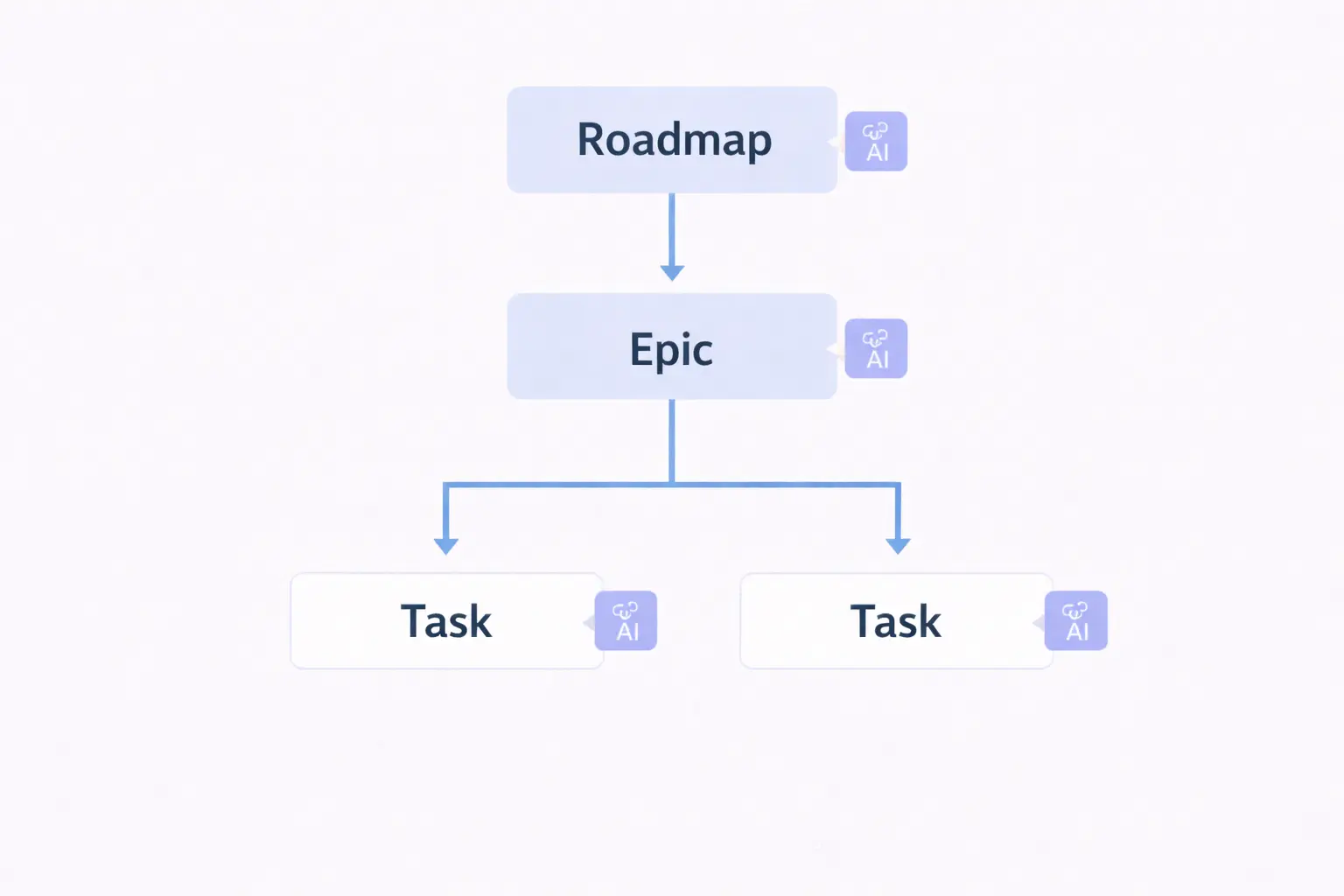
Setup time is measured in hours. The node structure is intuitive — open a task, assign an owner, write a deadline. Context depth exists: descriptions, file references, decision records. Finance module means operations and financial tracking in the same system. Technical and non-technical team members can work in the same tool.
Fits: 3–20 person startup, post-MVP, while the team is growing.
When Should Alios Be Chosen?
The situations where Alios stands out:
You don't have time for Jira setup. The system needs to work this week. You don't have weeks for configuration.
The team is a mix of technical and non-technical. Developer, designer, sales, founder all in the same system. Developer-focused tools leave non-technical members out.
Context matters as much as task tracking. Not just "what will be done" but "why it will be done, how the decision was made, where the related file is" — all in the same place.
You want operations and finance in the same system. Client tracking, invoicing, payment — you can't do these in Jira. In Alios, task management and financial tracking run together.
The team is changing. A new person should be able to quickly grasp the context. Decision history living in node descriptions reduces onboarding cost.
You want to reduce tool count. Instead of Notion + Jira + a separate accounting tool — one system is enough.
Alios's Limits
To be straightforward, Alios isn't ideal for every scenario.
Large engineering teams past 20 people that need enterprise approval workflows are better served by Jira or Linear. Teams doing detailed sprint metrics and velocity tracking will find that Jira's capabilities in this area don't exist in Alios. In large projects with very complex dependency structures, Jira's advanced linking features stand out.
Tool selection isn't a "best tool" decision — it's a "right tool for this stage" decision. And this decision can change over time.
Final Thought
The most common mistake when looking for a small team Jira alternative is comparing features. The more useful question is: which team, how many people, at what stage, solving which problem?
Jira is a powerful tool — but its power was designed for a specific scale and complexity. Staying below that scale makes Jira a burden, not a strength.
Alios was designed for this gap: fast setup, high visibility, deep context. Too simple for a large team, exactly right for a small one.