Article
Post-MVP Scaling: Set Up a Project Management System in 1 Week
Growing workload after MVP breaks most startups. Learn how to set up a post-MVP project management system in Alios with minimum configuration in just one week.
Post-MVP Scaling: Set Up a Project Management System in 1 Week
During the MVP phase, everything is manageable. A three-person team, speed, the "keep it all in your head" system, two meetings a day. Everyone knows everything because everyone is inside everything. In this period, there's no need for a project management tool — the team is literally on top of each other.
Then something changes. The first customers arrive, the team grows, the work multiplies. Nobody knows everything anymore. "Where did this end up?" gets asked five times a day. Priorities clash. Two people work on the same thing. Delays start.
The post-MVP period is exactly this inflection point. And most startups either try to build an overly complex system at this point, or keep putting it off. Neither works.
Why Post-MVP Workload Breaks Down
The "keep it in your head" approach that worked during the MVP phase doesn't scale. The reason is simple: when knowledge is tied to people, the system breaks as the number of people grows.
Verbal coordination that works with two people turns into chaos with five. The WhatsApp group that barely manages with five becomes a graveyard of information with ten. Every new team member steals time from someone else while learning the system. Every new client request upends existing priorities.
On top of that, the types of work multiply after MVP. It's no longer just product development — there's customer support, the sales process, onboarding, technical debt, new features, marketing. All of it piles onto the same small team with no structure to manage any of it.
The Minimum Setup Principle
The wrong move at the post-MVP stage is this: deciding to "build a proper system" and spending weeks researching, testing, and configuring. While that's happening, work keeps piling up.
The right approach is the exact opposite: build the simplest possible system in the shortest possible time, then improve it while you use it.
In Alios, this minimum setup is completed with four components.
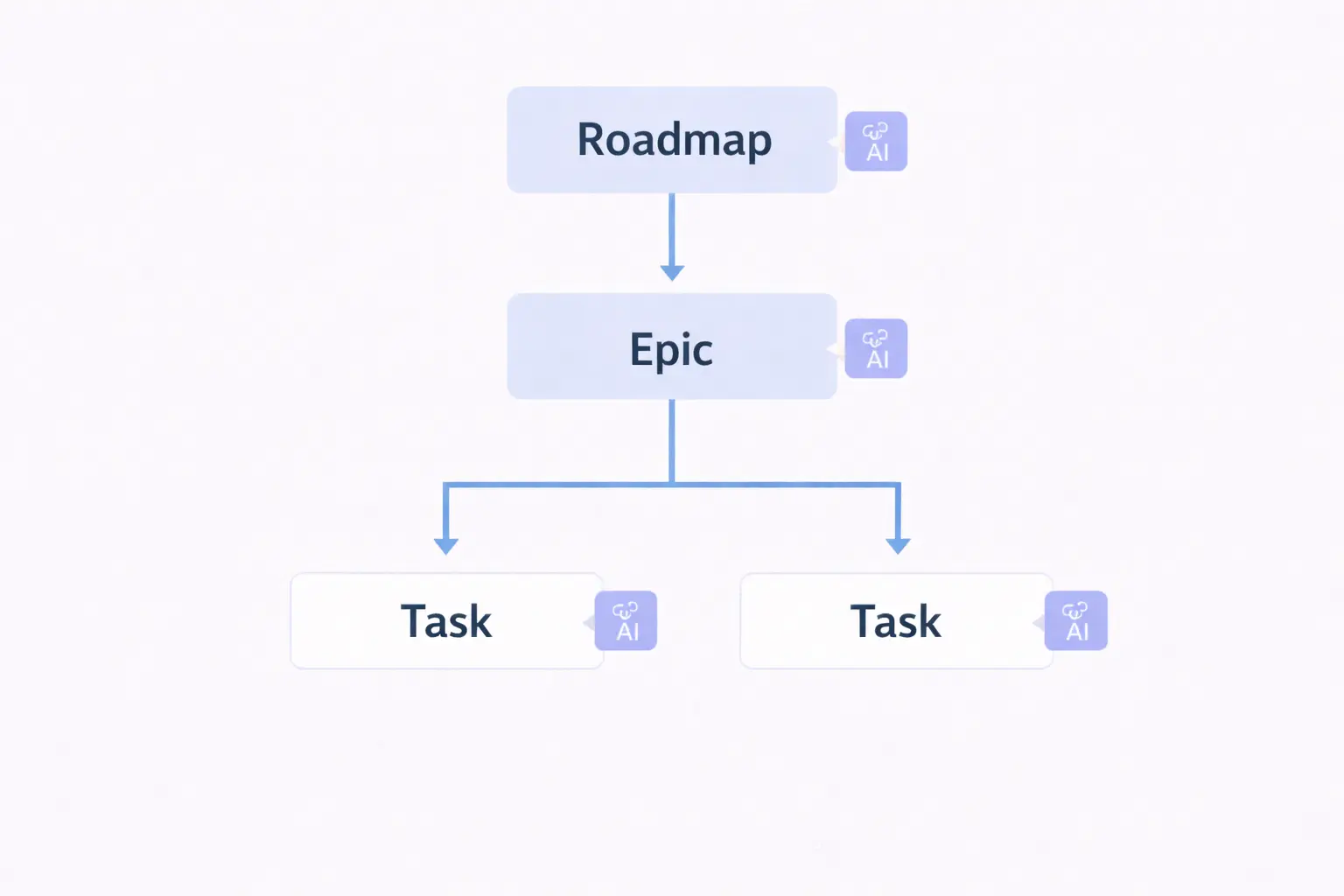
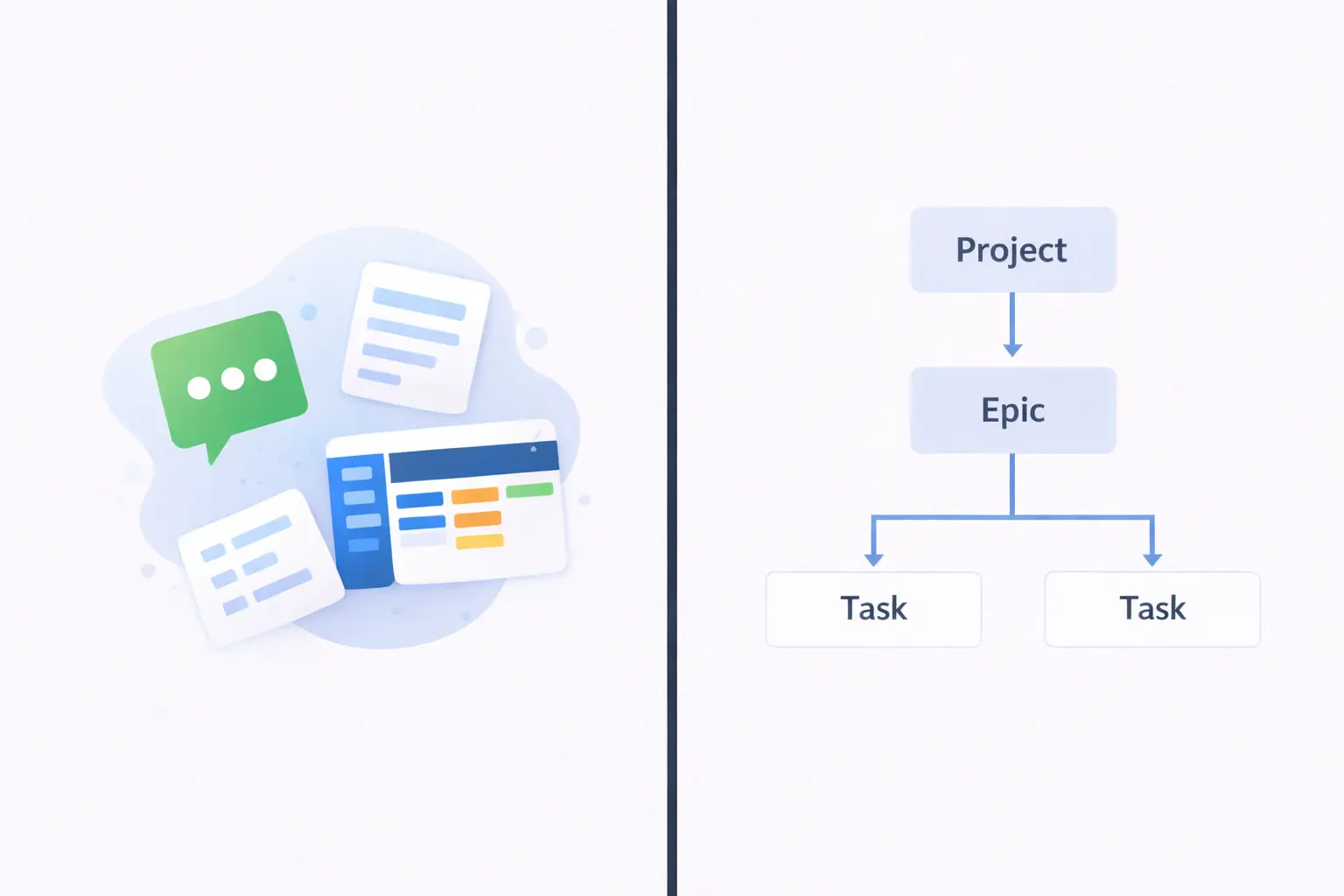
Project tree: One top-level node for each active project or work area. Tasks underneath it. The hierarchy starts with two layers — no more is needed.
Statuses: To Do, In Progress, Waiting, Done. Four statuses is enough. Before building complex workflows, these four need to be used consistently.
Owners: Every node has one owner. No ownerless tasks. No "the team will do it" as an owner.
Deadline: A date on every node. A task without a date can't enter the priority queue.
Once these four components are in place, the questions "where, who, when" are answered. Everything else — templates, automations, reports — gets layered on top of this over time.
Example: 1-Week Setup Checklist
The plan below is enough to build a working system from scratch in Alios. Maximum 30–45 minutes per day.
Monday — Build the Project Tree
✅ List your active projects (on paper or in your head)
✅ Open one top-level node in Alios for each project
✅ Write the project's 2–3 sentence purpose in the
   top node description
✅ Add currently active tasks as child nodes
✅ Assign an owner to each task

Goal: All active work is visible in the system.
Time: ~45 minutes
Tuesday — Add Statuses and Deadlines
✅ Review each node, select a status
   (To Do / In Progress / Waiting)
✅ Add a deadline to each node
   (if date unknown, mark as "this week" or "this month")
✅ Identify ownerless nodes, assign an owner
✅ Mark tasks that need to be done this week as
   "High priority"

Goal: Every task has an owner and a date.
Time: ~30 minutes
Wednesday — Bring the Team In
✅ Invite team members to Alios
✅ Show each person their own nodes
✅ Explain the "update the node when status changes" habit
✅ Set the rule: look at the node before asking
✅ Create the first daily check-in nodes

Goal: The team starts using the system.
Time: ~30 minutes (together with the team)
Thursday — Clean Up the Backlog
✅ Pull out the "will do, but no date yet" list
✅ Add these tasks to Alios as "Low priority" nodes
✅ Close or delete tasks that are no longer valid
✅ Merge overlapping or duplicate tasks
✅ Add backlog review to the calendar
   (once a week, 15 min)

Goal: Everything in your head and scattered lists
is in the system.
Time: ~45 minutes
Friday — First Review
✅ Completed nodes closed?
✅ Nodes that couldn't be completed — why? →
   written into description?
✅ Priority nodes identified for next week?
✅ What goes from backlog into next week decided?
✅ Short "how did this go?" feedback collected from team?

Goal: Evaluate the first week of the system,
prepare for the next.
Time: ~20 minutes
What Should Be True After Week One?
By the end of the week, the answers to these three questions should be visible in the system.
Who is doing what? Every active task has an owner, its status is clear.
When does it finish? Every task has a deadline, this week's priorities are marked.
What does the overall picture look like? At a glance, which project is moving and which is stuck is visible.
If these three questions have answers, the post-MVP project management system is in place. The rest — templates, automations, reports — gets added incrementally on top of this foundation.
Week Two and Beyond
Week one was spent building the system. Week two is for working with it.
At this stage, the only thing to do is: keep the nodes current. When a task starts, the status gets updated. When a task finishes, it gets closed. When a blocker appears, it gets written in the description.
Once the habit settles, "where does this stand?" naturally starts to decrease. The weekly review drops to 15 minutes. Team meetings shift from "what are we doing?" to "how can we do this better?"
Post-MVP project management doesn't require a big setup. One week, four components, consistent use — that's enough.
Final Thought
Startups that navigate the post-MVP inflection point are generally not the ones using the best tools. They're the ones using any system consistently.
Starting with a minimum setup in Alios — project tree, statuses, owners, deadlines — makes that consistency possible. If the team is still asking "what are we doing?" a week later, the system is incomplete. If that question has disappeared, the system is built.