Article
New Employee Onboarding: First 7-Day Task List with Alios
Without a standard onboarding process, every new hire starts from scratch. Learn how to build a reusable 7-day onboarding checklist in Alios that actually gets followed.
New Employee Onboarding: First 7-Day Task List with Alios
The first week at a new job is rarely as structured as it looks from the outside. There's usually a flurry of tool invites, a few introductory calls, and then a quiet moment where the new hire thinks: "So... what exactly should I be doing right now?"
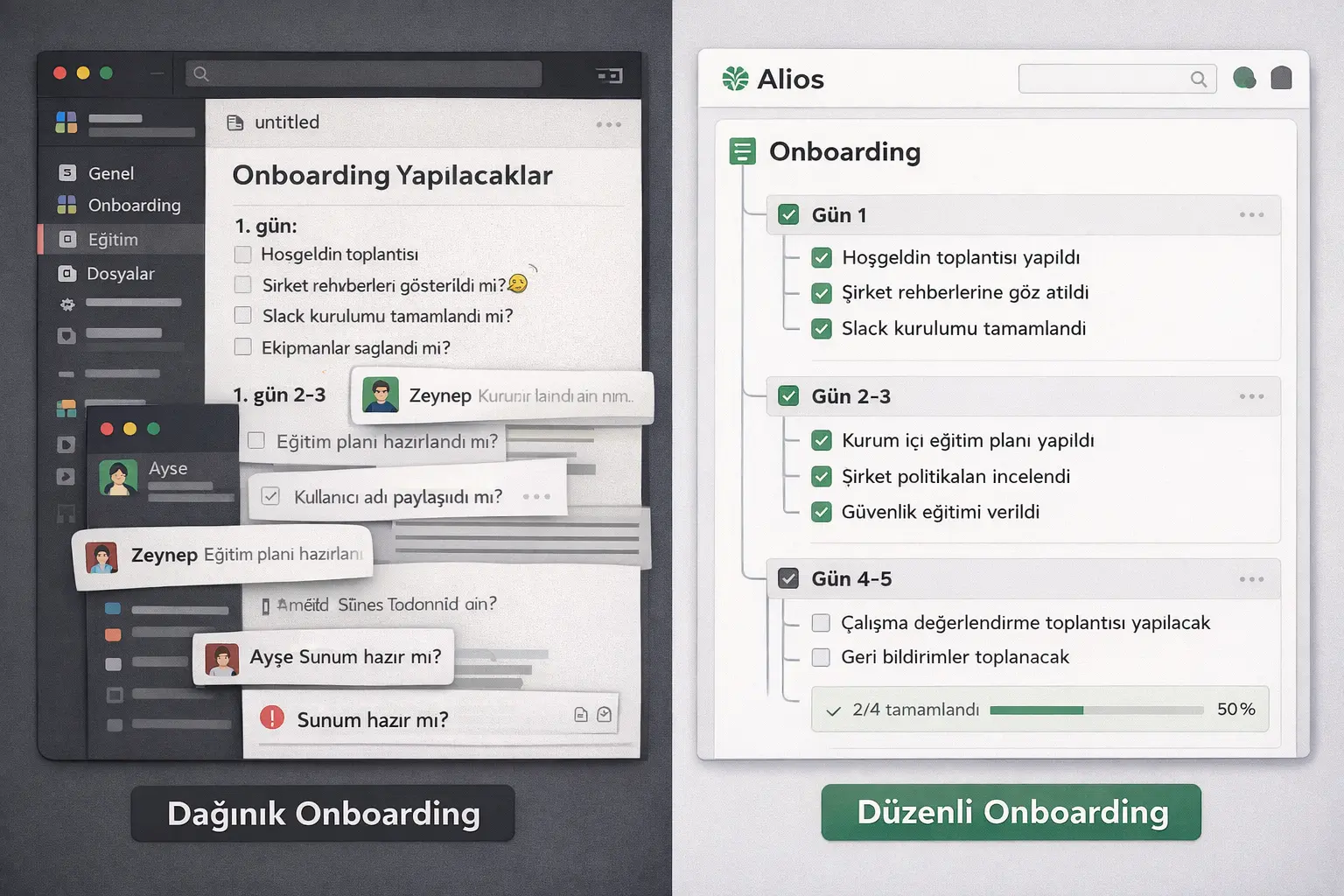
This isn't a people problem. It's a process problem. When onboarding lives in someone's head — or in a Google Doc that was last updated eighteen months ago — every new hire gets a different version of it. Some things get covered, some don't. The new person fills in the gaps by guessing or asking repeatedly.
The cost isn't just the new hire's lost time. It's the senior team member who answers the same questions every cycle, the context that never gets transferred, and the weeks it takes before someone is genuinely contributing.
Why Onboarding Without a Standard Breaks Down
Unstructured onboarding produces three consistent problems.
Inconsistency across hires. The first hire got a thorough walkthrough because the founder had time. The third hire joined during a busy sprint and got a 20-minute call and a Notion link. Both are expected to perform at the same level two weeks in.
Critical steps get skipped. Without a checklist, coverage depends on whoever is running the onboarding that week. Security setup, tool access, understanding the decision-making process, knowing who owns what — these get skipped not out of negligence but because there's no system requiring them.
No visibility for the manager. The new hire says "I'm good" because they don't know what they don't know. The manager assumes things are fine. Three weeks in, it becomes clear that a foundational misunderstanding has been shaping all of the new hire's work.
The Alios Approach: Copyable Onboarding Tree
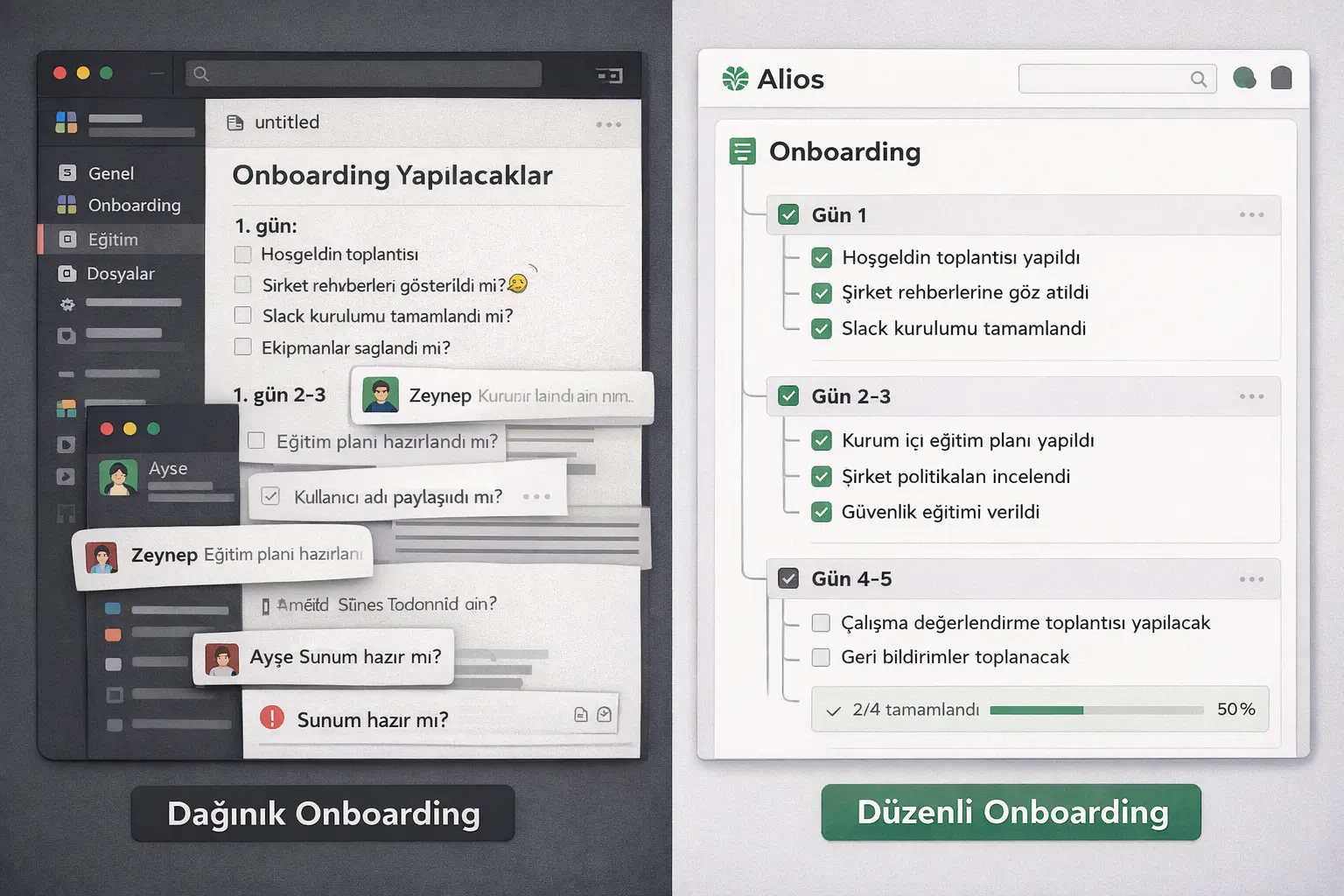
In Alios, onboarding is a node tree that gets copied for every new hire. The structure is built once, refined after each onboarding cycle, and copied at the start of the next one.
Each new hire gets their own onboarding node with their name and start date. The manager assigns it, the new hire works through it, and the status of every item is visible to both without a check-in call.
📁 ONBOARDING — [Name] — Start date: [Date]
Owner: [Manager name]
Status: In Progress
Goal: Independent contributor by end of Week 2

📁 DAY 1 — Access and Orientation
📁 DAY 2 — Tools and Process
📁 DAY 3 — Team and Context
📁 DAY 4-5 — First Real Work
📁 DAY 6-7 — Review and Next Steps
The 7-Day Checklist
Day 1 — Access and Orientation
- [ ] Accounts set up
      Alios, Slack, GitHub, Notion, email, calendar
      Owner: Manager — completed before Day 1

- [ ] First meeting: 1:1 with manager (30 min)
      Agenda:
      - What does success look like in Week 1 and Week 2?
      - How does the team communicate?
      - What should NOT be done without asking first?

- [ ] Company overview document read
      Link: [doc]
      Output: 2-3 questions written in onboarding node

- [ ] Team introductions
      Who to meet: [List of names and roles]
      Format: Async message or brief call — new hire's choice

- [ ] Onboarding node reviewed
      New hire reads the full 7-day plan
      Confirms: "I understand what's expected this week"
      → Status updated: Day 1 In Progress
Day 2 — Tools and Process
- [ ] Core tools walkthrough
      Alios: how the project tree works, how to
      update node status, where to find active work
      Slack: which channels matter, what goes where
      GitHub: branching convention, PR process
      [Other tools specific to role]

- [ ] How decisions get made
      Read: [Decision log or process doc]
      Key question answered: "If I disagree with
      something, what's the right way to raise it?"

- [ ] Where to find past decisions
      Find one recent decision in Alios decision log
      Output: Summary written in onboarding node —
      what was decided and why

- [ ] Definition of Done
      Read: What "done" means for tasks in this team
      Acceptance criteria format understood

- [ ] End of day: status update in onboarding node
      What was covered, what's unclear, any blockers
Day 3 — Team and Context
- [ ] Current sprint or project overview
      Manager walks through active Alios tree: 20 min
      Output: New hire can answer "what is the team
      working on right now and why?"

- [ ] Read last 3 sprint retrospective notes
      Where to find them: [Link or node]
      Output: One observation written in onboarding node
      "Something I noticed that I want to understand better"

- [ ] Shadow one real work session
      A PR review, a planning meeting, a customer call —
      whatever is most relevant to the role
      Output: Notes written in onboarding node

- [ ] 1:1 with one team member (not manager)
      Goal: Understand their role, their current focus,
      and one thing they wish they'd known in Week 1

- [ ] Clarify first real task
      Manager assigns first task in Alios
      New hire reads it and writes acceptance criteria
      in their own words — manager confirms or corrects
Day 4–5 — First Real Work
- [ ] First task started
      Node status updated: In Progress
      Any blockers written in node description immediately

- [ ] At least one node updated per day
      Not a report — a status update:
      "Where am I, what's next, is anything blocked?"

- [ ] First PR opened or first deliverable submitted
      (adjusted to role — designer submits first draft,
      marketer submits first copy, etc.)

- [ ] Asked at least one question in the right channel
      Not "I don't want to bother anyone" — asking
      in the right place is part of the job

- [ ] Mid-week check-in with manager (15 min)
      3 questions:
      - What's going well?
      - What's unclear or blocked?
      - Is the first task scoped correctly?
Day 6–7 — Review and Next Steps
- [ ] First task completed or clearly scoped to Week 2
      Node status: Done or moved with explanation

- [ ] Onboarding node reviewed with manager
      Every item checked or marked with a note
      Uncovered items: flagged, not ignored

- [ ] New hire writes onboarding retrospective
      3 questions, written in onboarding node:
      - What was useful in this first week?
      - What was missing or unclear?
      - What would have helped on Day 1 that I didn't have?

- [ ] Manager reviews retrospective and updates template
      One or two improvements added to the master
      onboarding template before the next hire

- [ ] Week 2 plan agreed
      At least 3 concrete tasks in Alios
      Owner assigned, deadlines set, acceptance criteria written

- [ ] Onboarding node status: Done
      Only when all items are checked or
      explicitly deferred with a reason
The Master Template: How to Keep It Current
The onboarding node tree is a living document. After each hire, the manager spends 15 minutes updating the master template based on the retrospective:
📁 ONBOARDING MASTER TEMPLATE
Last updated: [Date] — after [Name]'s onboarding

Changes from last cycle:
- Added: "Read last 3 sprint retrospectives" — Day 3
  Reason: [Name] felt she had no context on team patterns
- Removed: "Confluence walkthrough" — Day 2
  Reason: Team stopped using Confluence in Q2
- Updated: Definition of Done link — now in Alios node
  instead of Notion

Next review: After [Next hire]'s Week 1 retrospective
This 15-minute update compounds. By the fifth hire, the onboarding template reflects five cycles of real feedback. The sixth hire gets an onboarding experience that's genuinely good — not because someone worked harder, but because the system improved.
What the Manager Sees
In Alios, the manager doesn't need a check-in call to know where the new hire stands. The onboarding node tree shows it:
📁 ONBOARDING — Alex Chen — Started March 10

Day 1 ✅ — All items done
Day 2 ✅ — All items done
Day 3 🔄 — In Progress
  ✅ Current sprint overview — done
  ✅ Read retrospectives — done
  ⏳ Shadow work session — scheduled for this afternoon
  ⬜ 1:1 with team member — not yet
  ⬜ First task clarified — not yet

Day 4-5 ⬜
Day 6-7 ⬜
One glance. No status meeting needed.
Final Thought
Onboarding without a standard isn't onboarding — it's improvisation. Some new hires handle improvisation well. Most don't, and the team pays the cost in repeated questions, slow ramp-up, and the quiet frustration of a person who wanted to contribute but didn't know how.
In Alios, the 7-day onboarding checklist is copied, assigned, and tracked like any other project. The new hire knows what's expected. The manager knows what's been covered. The template gets better after every cycle.
The first week is still hard. But it doesn't have to be uncertain.