Article
Connecting Your Product Roadmap to Daily Work: The Alios Model
Roadmaps usually stay in a document and never reach daily work. Learn how to set up product roadmap management in Alios using a goal, epic, and task hierarchy.
Connecting Your Product Roadmap to Daily Work: The Alios Model
Most startups have a roadmap. A page in Notion, a board in Miro, or at least a clear vision in someone's head. But on Monday morning, when the team decides what to work on, nobody looks at that roadmap. And even when they do, it's not clear how to get from a line like "Q3 — payment system" to an actual daily task.
The roadmap lives in a document. Work happens somewhere else. The two never meet.
Over time, this gap becomes a serious problem: the team works hard but the work's contribution to the roadmap stays invisible. The quarter ends — how much did the goal actually advance? Nobody knows.
Why Roadmaps Stay in Documents
There's one reason roadmaps don't translate into practice: there's no bridge between abstract goals and concrete tasks.
"Improve the payment system" is a goal. But how to get from that goal to "bring payment page load time under 2 seconds," and from there to "optimize the frontend bundle" — none of that is written down. The translation happens in someone's head, and when heads change, the connection breaks.
On top of that, roadmap tools are usually separate from task tools. Roadmap in Notion, tasks in Jira. Keeping the two manually in sync takes time and isn't sustainable. The roadmap quickly loses currency, tasks become untethered, and before long strategy lives in one place while operations run in another. The team works every day but gradually loses sight of where they're headed.
The Three-Layer Hierarchy in Alios
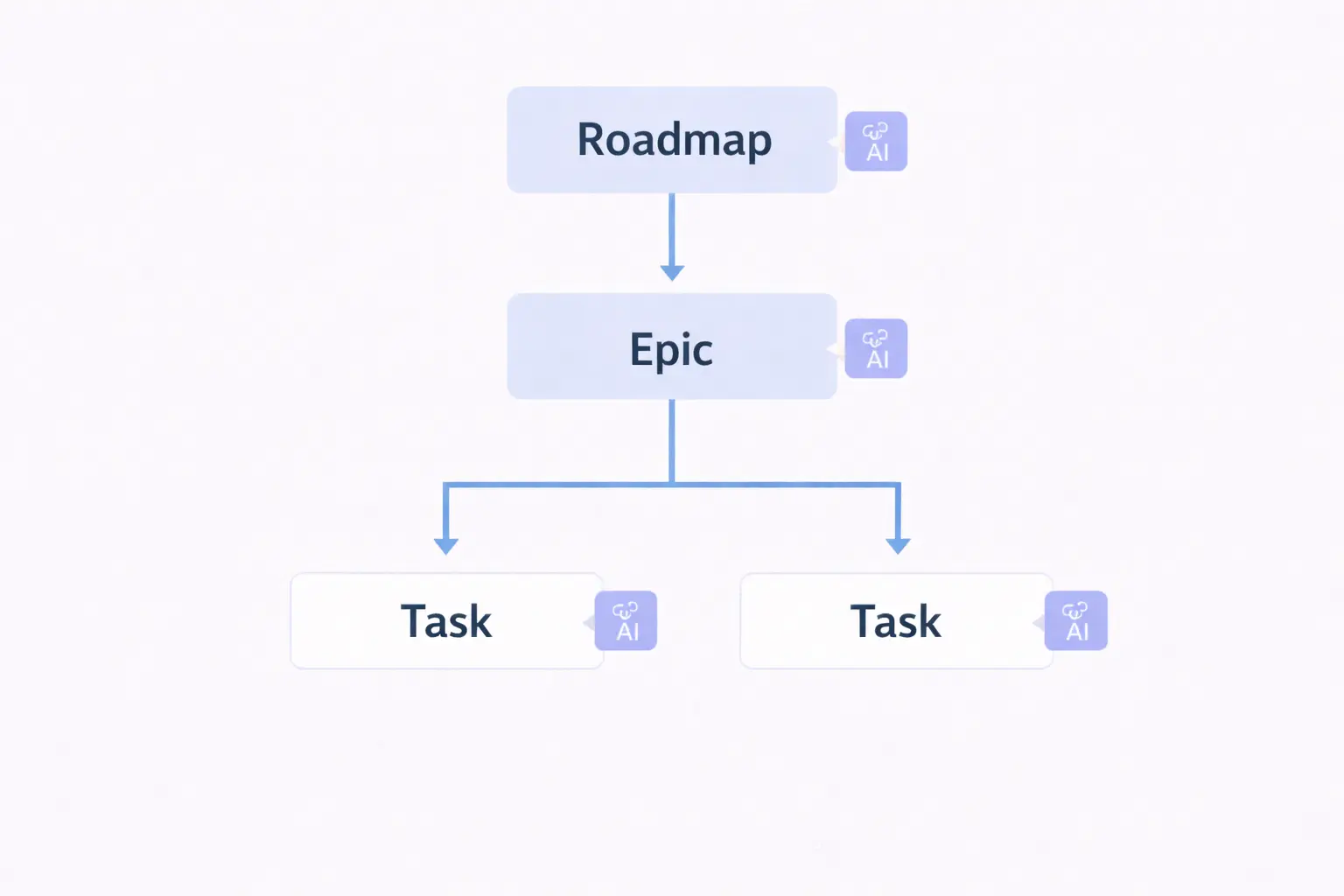
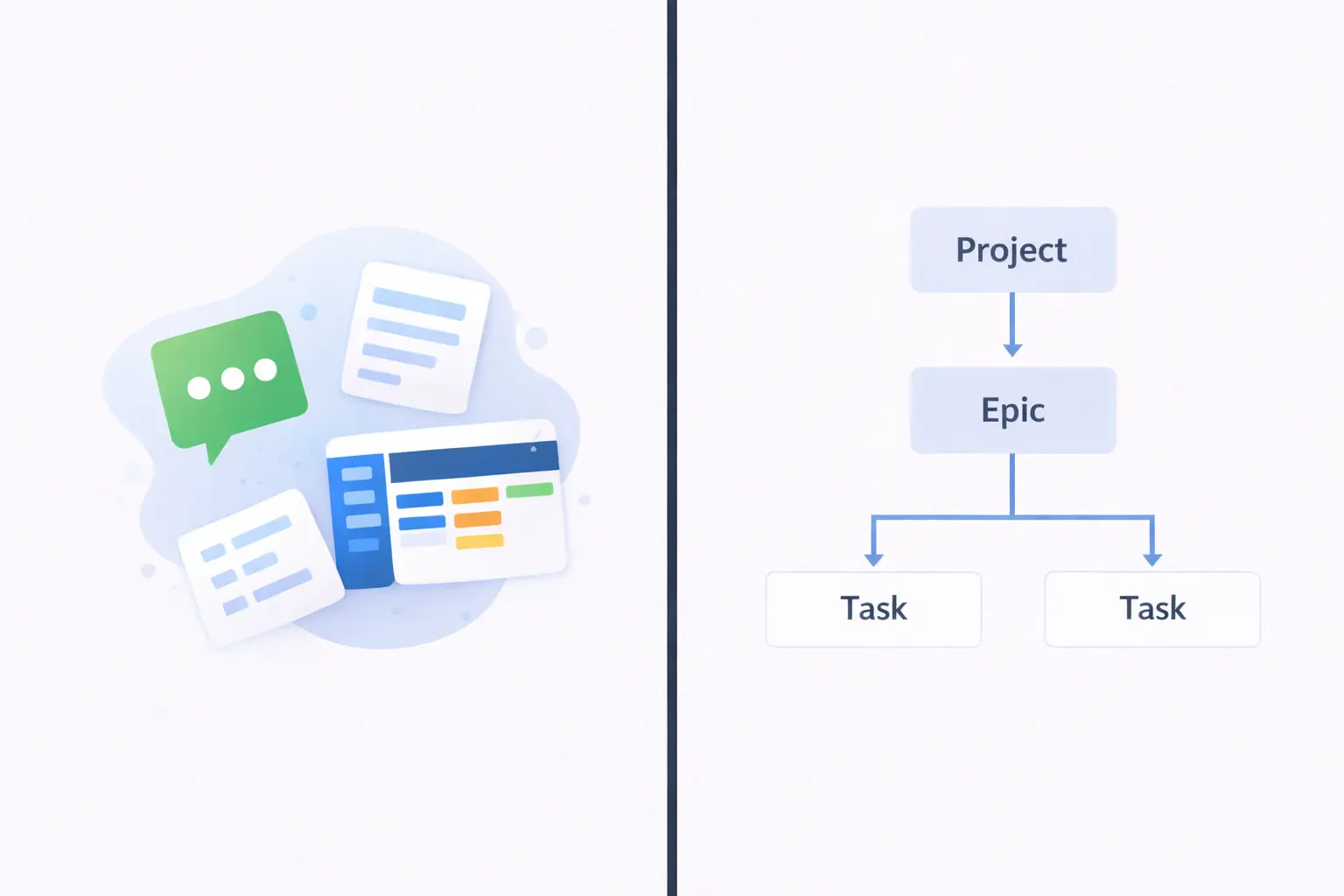
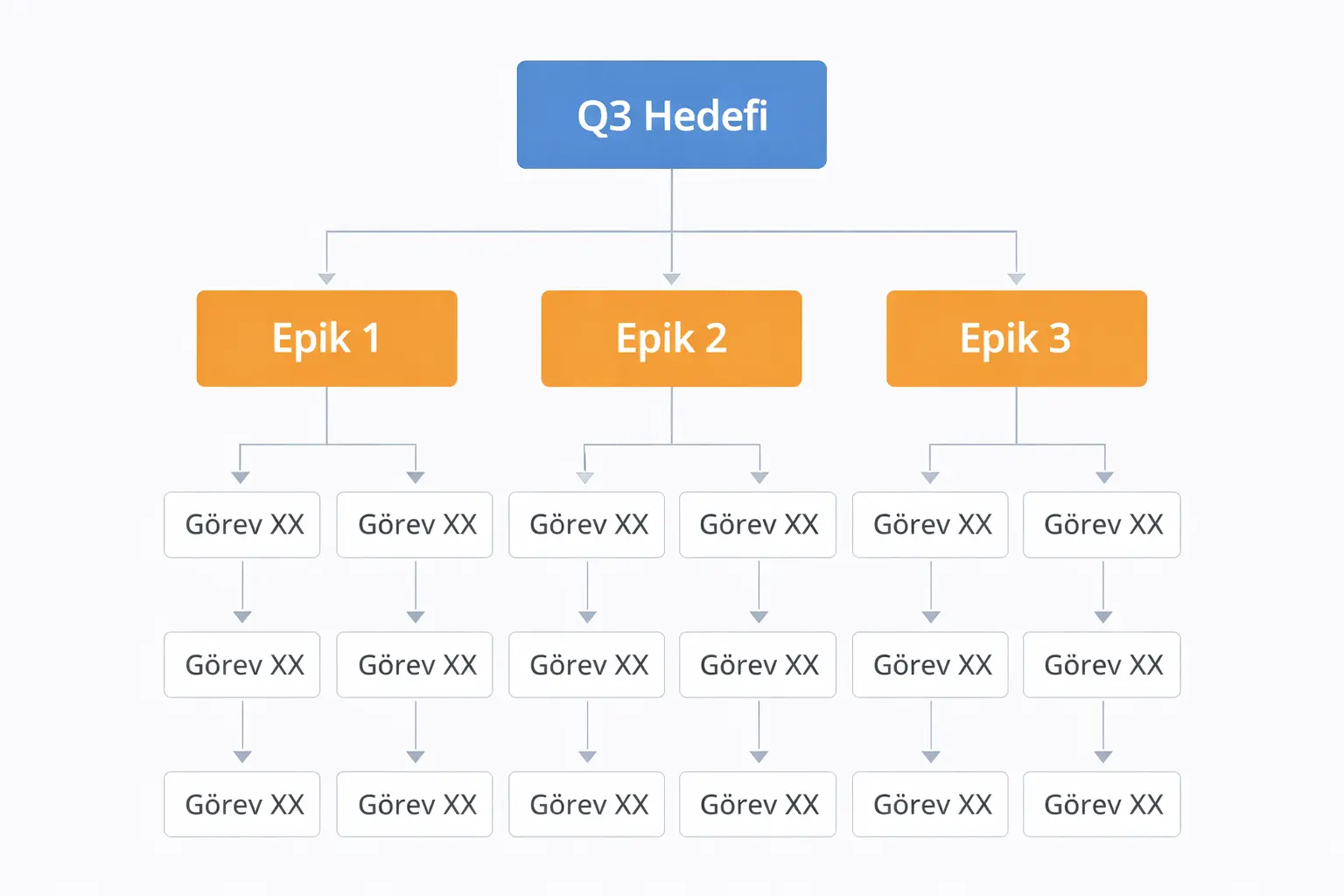
In Alios, this gap can be closed by building the node structure around a three-layer hierarchy: top-level goal → epic → task.
Top-level goal: The strategic priority from the roadmap. A node defined quarterly or annually that shows where the company wants to go. Example: "Q3 — Improve the Payment Experience."
Epic: Groups of related work that break the top-level goal into pieces. Each epic is meaningful on its own but isn't considered complete in isolation. Examples: "Payment Page Performance," "New Payment Method Integration," "Error Message Improvements."
Task: Concrete, assignable, completable work items under each epic. Sized so one person can finish them within a sprint. Examples: "Analyze frontend bundle," "Test Stripe webhook integration," "List error codes."
When these three layers live together in the same system, the bridge between the roadmap and daily work builds itself. The developer knows which task to open in the morning. The founder can track how far each epic has progressed by the end of the quarter.
Example Roadmap Tree
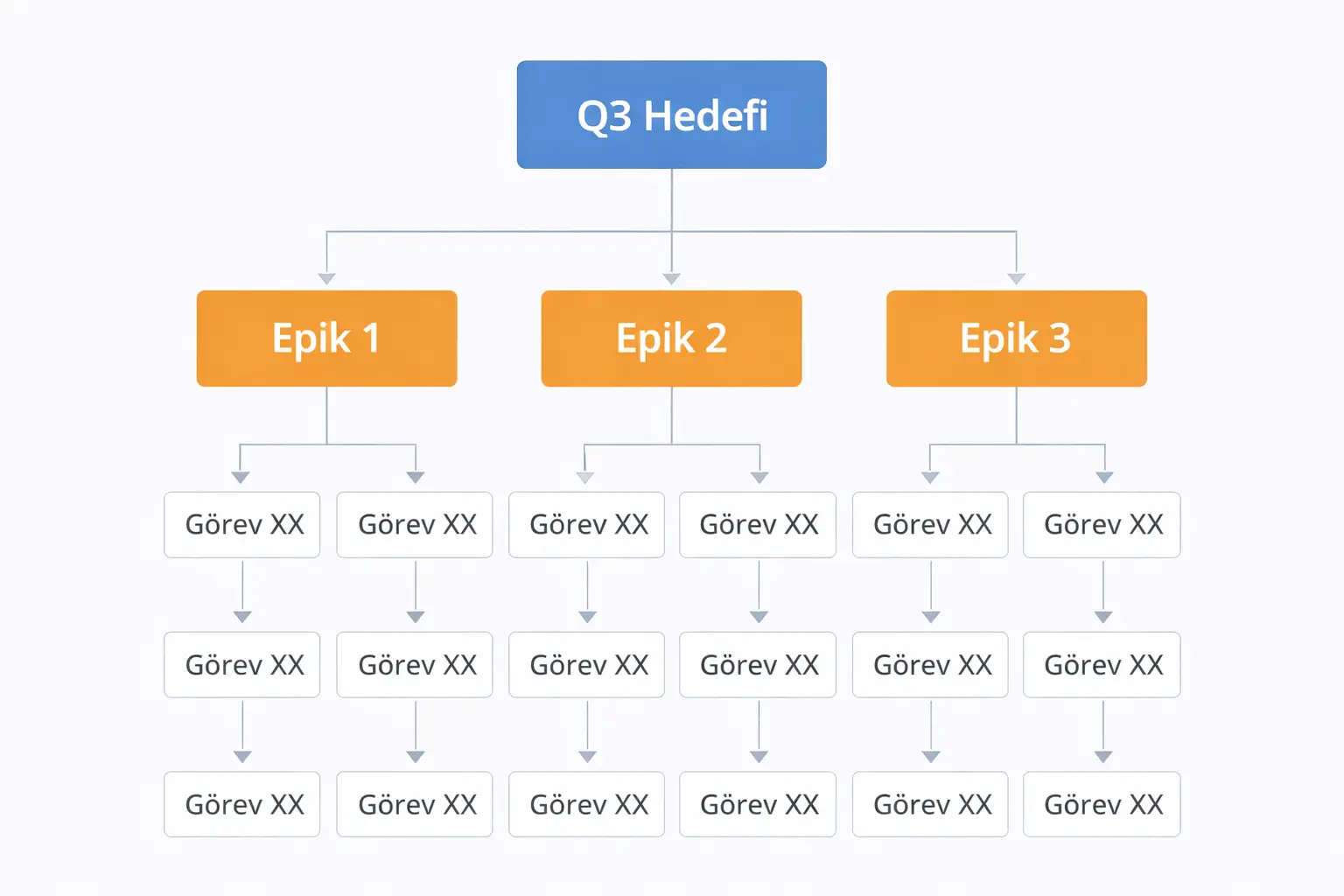
The structure below can be built directly as a node hierarchy in Alios:
📁 Q3 GOAL — Improve the Payment Experience
│
├── 📁 EPIC 1: Payment Page Performance
│   ├── [ ] Analyze frontend bundle size — Owner: Ali
│   ├── [ ] Remove unnecessary JS dependencies — Owner: Ali
│   ├── [ ] Run load time benchmark — Owner: Ayşe
│   └── [ ] Prepare performance report — Owner: Ayşe
│
├── 📁 EPIC 2: New Payment Method Integration
│   ├── [ ] Review Stripe documentation — Owner: Mehmet
│   ├── [ ] Set up integration in sandbox — Owner: Mehmet
│   ├── [ ] Write end-to-end test scenarios — Owner: Ayşe
│   ├── [ ] Get QA sign-off — Owner: Ayşe
│   └── [ ] Deploy to production — Owner: Mehmet
│
├── 📁 EPIC 3: Error Message Improvements
│   ├── [ ] List existing error codes — Owner: Zeynep
│   ├── [ ] Write user-friendly message copy — Owner: Zeynep
│   ├── [ ] Integrate into frontend — Owner: Ali
│   └── [ ] Validate in user testing — Owner: Ayşe
│
└── 📋 TOP-LEVEL GOAL NOTE
    Start: July 1 — Target: September 30
    Success criteria: Payment completion rate +12%,
    avg. load time under 2s, error rate -30%
In this structure, every task is linked to an epic above it, and every epic to a top-level goal. When a task is completed, it's visible which strategic priority it contributes to. The roadmap no longer lives in a document — it lives inside the tasks.
Things to Watch When Building This Structure
Keep the number of top-level goals small. More than 3–4 goals per quarter fragments focus. The broader the roadmap, the more meaningless the epics and tasks beneath it become.
Epics should be independently deliverable. The "Payment Page Performance" epic should be closeable even before "New Payment Method" is done. Epics don't need to wait on each other.
Tasks should be sized for a single owner. "Develop the payment system" is an epic, not a task. A task should be something one person can complete in one or two days.
Write success criteria in the top-level goal node. Words like "improve," "develop," and "optimize" are unmeasurable. When a numerical target is entered in the node description, the question "did we succeed?" has a clear answer at the end of the quarter.
Final Thought
The gap between a roadmap and daily work isn't a tool problem — it's a structure problem. When a top-level goal, epic, and task hierarchy are built inside the same system, that gap closes on its own.
Product roadmap management in Alios doesn't require a separate tool. When the node hierarchy is set up correctly, strategy and operations meet on the same screen. The developer sees why today's task matters. The founder can track where the quarter is heading.